



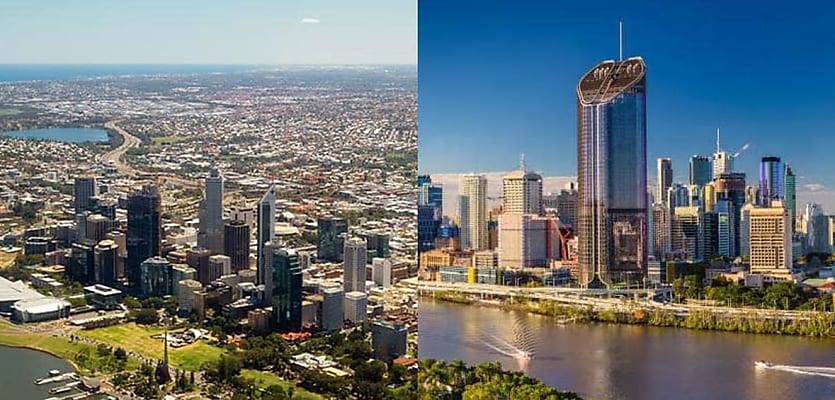

The mid-sized capitals have switched gears, with values falling at a record pace across Perth, Brisbane and Adelaide, costing homeowners almost $100,000, according to recent data.
The downturn in Australia’s mid-sized capitals continues to accelerate, with annual values in Brisbane, Perth and Adelaide declining at the fastest rate on record, according to Cotality’s latest data.
Property values in Perth fell the fastest among the mid-sized capitals, down 8.9 per cent over 2026.
While the Western Australian capital’s median value surpassed the $1 million mark in March this year, the city has plummeted to $942,018 over the past six months.
The drop represents a material loss of around $75,000 dollars for homeowners.
Recent Real Estate Institute of Western Australia (REIWA) data found that almost 50 per cent of homes across Perth were selling below their asking price, for an average discount of 7.5 per cent, as stock levels rise.
REIWA president Rob Mandanici said the city had seen an influx of new listings come to market, but fewer buyers willing to transact.
He said first home buyers and investors had both lost confidence in the market, with borrowing capacity and changes to negative gearing weighing on sentiment.
“We’ve seen new listings increase as sellers look to make the most of one of the busiest selling periods of the year. However, buyer demand has dropped significantly over the past year,” Mandanici said.
“While demand started to ease earlier this year, multiple interest rate increases, the rising cost of living, and the Federal Government’s changes to taxation policy in May have exacerbated the trend.”
Brisbane and Adelaide follow similar trends
Brisbane followed closely behind with a value drop of 8.3 per cent, bringing the river city’s median value to $1,018,401.
The river city median value peaked at $1,116,180, and the current value fell by almost $100k.
Despite recording a more moderate decline, Adelaide’s 4.4 per cent drop was still the steepest ever for the South Australian capital, with median values falling from $950,703 down to $916,860.
Cotality head of research Gerard Burg said that while the initial phase of the national downturn had been led by the larger capitals, the more resilient mid-sized capitals were now experiencing an unprecedented rate of decline.
“These mid-sized capitals are now experiencing their fastest downturn on record. Strong growth in home values in these markets post-COVID-19 substantially stretched affordability metrics, increasing the demand-side pressures associated with rate hikes this year,” Burg said.
Across the combined capitals, home values have declined for seven consecutive months, with cumulative losses of 8.1 per cent, the fastest decline recorded in more than 40 years.
Compared to 12 months ago, values across the capitals have declined by 4.8 per cent, highlighting how quickly the capitals moved from growth to downturn.
Burg warned that the record decline showed no signs of slowing.
“The largest peak-to-trough downturn at least over the past 40 years across the combined capital cities was 8.2 per cent between October 2017 and May 2019.”
“Next month, the current downturn looks set to surpass this fall,” he said.
By comparison, Burg said the regional markets have seen a more moderate decline, dropping 3.1 per cent from their peak.
Looking down the road
Burg said the supply side of the market was showing early signs of adjustment, with Melbourne the first capital positioned for the next phase.
The Victorian capital has seen total stock fall 5.3 per cent below the five-year average in the four weeks to early November.
Conversely, Adelaide and Brisbane sit almost 25 per cent above the five-year average, while Perth’s stock levels were up eight per cent over the same period.
“A better balance between available supply and demand in Melbourne means home values in the city are falling at the slowest pace of the major capitals,” Burg said.
“A similar transition in other cities should eventually slow the declines elsewhere.”
He said a housing market recovery would have to wait until buyers had both the confidence and financial capacity to transact again.
“Affordability and investor policies are likely to remain constraints, meaning it is likely that rate cuts from the Reserve Bank will be necessary, which currently appears unlikely before the second half of 2027,” Burg said.
 Want to see more stories from trusted news sources?
Make Real Estate Business a preferred news source on Google.
