




Internal metrics tell you what happened. Benchmarking tells you whether you're winning, falling behind or leaving opportunities on the table.
For decades, real estate agencies have measured success using a familiar set of metrics. Listings secured, properties sold, average commission and revenue generated. These numbers matter, but increasingly, they're not enough because performance in isolation only tells part of the story.
An agency might be celebrating record results while competitors in the same market are growing twice as quickly. Another might believe performance is deteriorating when, in reality, the entire market has softened and they're actually outperforming their peers.
The question isn't simply, "How are we performing?" The more important question is, "How are we performing compared to everyone else?" That's why benchmarking is quickly becoming one of the most valuable capabilities in modern real estate technology.
As agencies face rising competition, tighter margins and changing customer expectations, understanding performance in context is becoming essential to making better decisions.
Reapit's latest Real Estate Intelligence Report, which analysed the activities of more than 52,000 Australian real estate professionals, found that market conditions continue to vary significantly across states and segments, with affordability pressures, buyer behaviour and rental demand creating different challenges and opportunities for every agency.
In an environment like this, relying solely on internal reporting can create blind spots. An increase in days on market, for example, may appear concerning until it's benchmarked against comparable agencies experiencing the same trend. Similarly, strong commission growth may feel like success until an agency discovers its competitors are delivering even stronger outcomes.
Benchmarking provides the missing context. Rather than simply reporting what happened, it helps agencies understand what their results mean and where action is needed.
With the introduction of advanced benchmarking capabilities in Reapit Sales Analytics+, agencies can compare performance against anonymised peer groups operating in similar markets. The result is a far clearer picture of where the business is excelling, where it's underperforming and where opportunities exist to improve.
According to Anne Porter, Global Head of Data at Reapit, the biggest challenge for agency leaders isn't access to information, it's understanding what good actually looks like.

"Most agencies know their numbers. Far fewer know whether those numbers represent strong performance or missed opportunity. Benchmarking provides the context that turns data into meaningful insight."
The ability to compare performance externally changes decision making in several important ways.
Firstly, it exposes gaps that may otherwise remain hidden. Underperforming branches, declining conversion rates or inefficient processes become much easier to identify when compared against industry benchmarks.
Equally, agencies can identify where they genuinely outperform competitors and use those strengths to drive further growth.
Secondly, benchmarking helps leadership teams make better investment decisions. When agencies understand which activities have the greatest impact on performance relative to their peers, they can direct time, resources and investment towards the initiatives most likely to generate results.
And thirdly, it creates a culture of continuous improvement. Performance conversations become less subjective and more evidence based. Teams gain a clearer understanding of expectations, and leaders have greater confidence in setting targets and measuring progress.
Simon Berglund, General Manager, ANZ at Reapit, believes this shift represents the next stage in the industry's evolution.
"The agencies pulling ahead today are the ones making decisions based on comparative, external data not just discreet, internal data. Benchmarking gives leaders the confidence to know where to focus, what to change and where they're genuinely creating competitive advantage."
The need for better insight has never been greater.
Reapit's Real Estate Intelligence Report found that national average days on market fluctuated from 51 to 64 days across the six months to February 2026, while tenant demand and rental conditions continued to vary considerably between states.
These differences highlight why market context matters. What represents exceptional performance in one region may be average in another. And knowing one’s comparative market position removes the guesswork. It helps agencies understand whether results are driven by strong execution, favourable market conditions or emerging risks that require attention.
Perhaps most importantly, it enables agencies to articulate their value more effectively. Rather than relying on subjective claims, leaders can confidently demonstrate to vendors, investors and stakeholders exactly how their business performs against the broader market.
The simple truth is this; without benchmarking, agencies know their numbers. But with benchmarking, agencies know what those numbers mean.
And in an increasingly competitive market, that difference may be what separates the agencies that grow from the agencies that stand still.
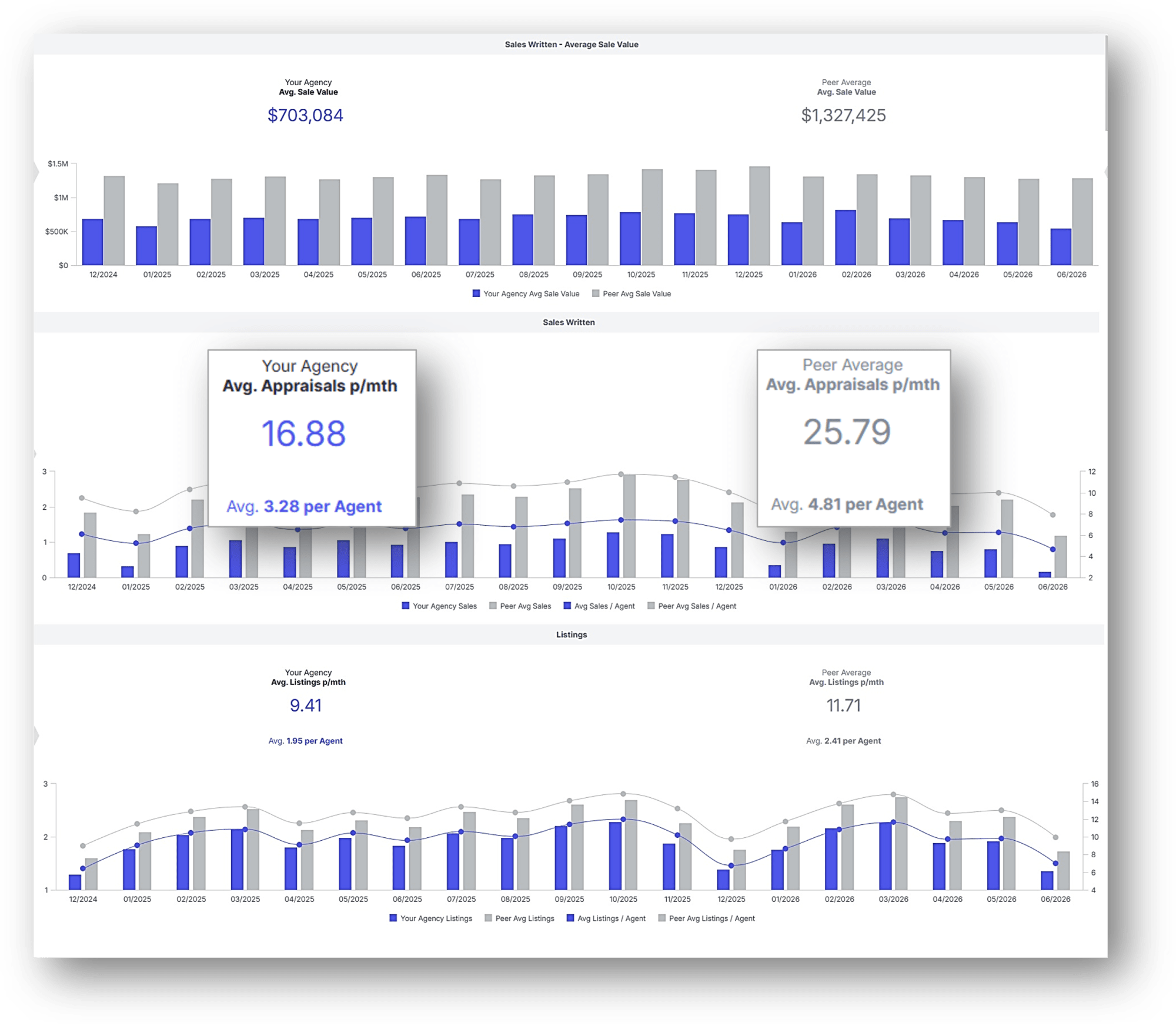
Ready to see how your agency compares? Learn more about benchmarking in Reapit Analytics+.