



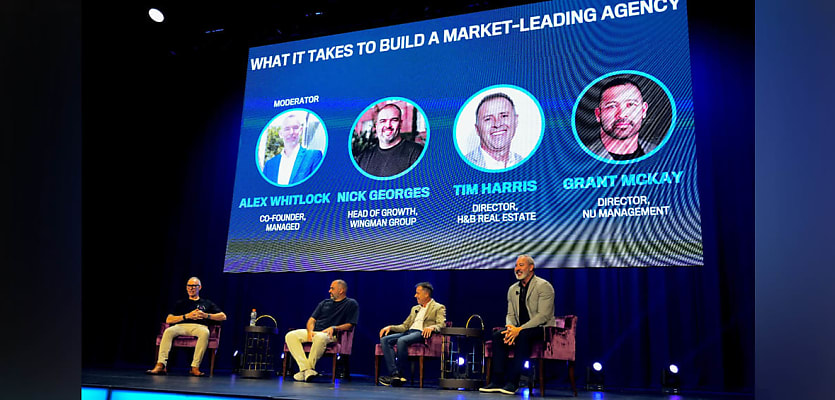

Building a successful property management business takes more than a large rent roll, with industry leaders warning agencies must rethink their teams, hiring and business models or risk falling behind.
As investors reassess their portfolios after tax changes and rising interest rates, property managers must strengthen their services and tighten their processes to attract new clients and achieve long-term growth.
At the Property Management Excellence Conference, H&B director Tim Harris, NU Management director Grant McKay, and Wingman Group director Nick Georges shared their advice on building a more efficient, sustainable and successful business.
The industry leaders said agencies needed to give staff clearly defined responsibilities and encourage them to take genuine interest in their work.
Additionally, they said that property management leaders should support and encourage their staff, and rethink traditional operating models when they no longer serve the business.
Here are the leaders’ top tips for building a market-leading property management:
Structure teams in accordance with goals
Harris said building an efficient team started with structuring offices around the agency’s goals, ensuring clearly defined responsibilities and that each individual was in the right role for them.
He said offices should have a decentralised structure allowing each staff member to perform particular tasks, rather than individuals being responsible for all aspects of a property portfolio.
He also said a more compartmentalised model ensured each member could hone in on specific tasks, allowing quality service for clients.
“Our communication hub is in the middle, but team members that come in will start in the maintenance area.”
“We’ll have a relationship manager, and we’ve got a leasing manager, and they form different functions, which allows them to be more concentrated in their job tasks.”
In addition, he said the structure allowed staff to develop their skills progressively without having to focus on too much at once.
“It’s more rewarding because they learn much quicker and they realise, oh, this is not that difficult. They’re quickly moving from one tier to another to broaden their knowledge as they go.”
According to Georges, agencies should never be afraid to alter their workplace structure where required, particularly if certain staff members require more support to help them carry out their role.
“If you’ve got a really good business development manager (BDM), they might only be out signing up properties and building relationships,” he said.
“Why can’t we look at a BDM like a $3 million agent, surrounding them with admin, with associates – whatever the structure is in your marketplace.”
Provide support and foster positive ethos
Rather than having a rigid approach to training new staff, McKay said it was important to foster a positive work ethos across teams and provide support, enabling retention and encouraging staff to perform better.
McKay said he always encouraged young leasing agents in his team to aim for success, despite criticism that he treated them too leniently.
“I approached bringing on a leasing person very differently than the industry does – others treat it as a starting point, ‘do your time there’,” he said.
By supporting and encouraging the individual, McKay said his team became more passionate about property management and building a rent roll, which reflected in performance.
“This guy will close a leasing deal for me without any KPI or incentive attached, and he’ll walk out of dinner on Friday night or call me on a Sunday to try and get that deal done,” he said.
According to Harris, agencies should inspire staff to become genuinely invested in the business’ outcomes, giving them a sense of purpose rather than simply performing basic tasks.
“A member comes in, we talk about being compliant, they’re doing the job, and then shifting from being compliant to taking responsibility and then from taking responsibility to taking ownership,” he said.
“I want acquisition down the track to be a team operation so that we’re buying together and we’re supporting each other in the way that we grow. And that’s the way we see the future.”
Be willing to change business models
According to Harris, sustainable growth requires property management businesses to recognise when their existing models were no longer working and be willing to change their approach.
He said property managers should always be open to changing their operations to achieve results, recognising when their current procedures were failing.
Initially, Harris achieved organic growth by converting his agency’s sales clients into property management clients, but soon realised the model was unsustainable at the time.
“We had a very small team, compliance was getting more difficult, Covid kicked in,” he said.
“It was about trying to anticipate further into the future with some strategic thinking, and the sales side of the industry had its pitfalls, and it was a lot of short-term sort of wins.”
After careful consideration, Harris said his team decided to acquire rent rolls instead of growing organically, as it gave the office greater opportunity with less risk.
“We started the process fairly trepidly – we were probably very naive in that first acquisition, and we learned a lot,” he said.
“We made some mistakes as well, but we realised that acquisition seems easy, but it’s actually very difficult, and there’s a lot of components to it you’ve got to get right.”
Hire motivated, ambitious staff
Even after adopting the right business model, Harris said leaders needed to hire the right people for the agency and the position.
He said agencies needed to look for ambitious and energetic individuals who took initiative and knew how to take action to achieve their goals.
“You’re looking for that little bit of spark, innovation, energy, something that shows you that they’re motivated to learn. They probably need a bit of personality and a bit of a thick skin at times as well,” he said.
Harris said one recent new starter at his business instantly expressed dissatisfaction with the layout of her desk space and instantly sought to change it, demonstrating a go-getter attitude.
“That’s exactly what I did when I first started in real estate – I was facing a wall. I just replaced a guy that got a sack, and I thought, ‘Well, this is not going to go real well, is it?’, So shift your chair, shift your reality.”
Similarly, McKay said agencies should hire team members with a customer-service approach and a desire to lift the industry’s standards, even in challenging moments.
“I would love to see new management become synonymous with just customer service, good experience, positive dealings, even under dispute kind of resolutions between tenants and landlords,” he said.
“It’s not about reaching a number for me; it’s about taking it to the industry and saying, ‘It’s a tough day-to-day role, but we can do better. We can change the energy, change the attitude.”
 Want to see more stories from trusted news sources?
Make Real Estate Business a preferred news source on Google.
