



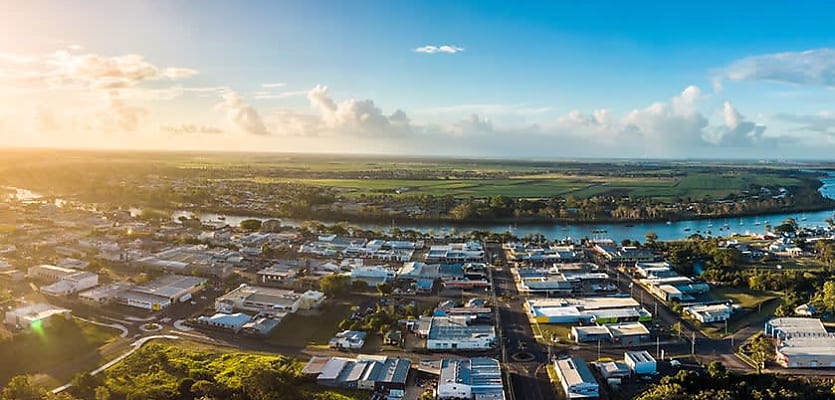

Regional property values are sliding twice as fast, with Queensland hotspots leading a nationwide correction and former high-flyers beginning to lose value.
The latest data from Cotality found that property value drops in regional Australia doubled as markets moved from resilience to broad decline.
Regional dwelling values fell by 2 per cent in the three months to October, almost doubling from the 1.1 per cent fall measured in the July quarter.
Once considered one of the country's hottest markets, Queensland has switched lanes, leading regional value declines nationwide, while the capital city market continues to struggle.
Values fell across regional Queensland by 2.7 per cent over the quarter, following a similar trend to its capital, where median values fell by 8.3 per cent over 2026.
Cotality head of research Gerard Burg said the downturn was beginning to take its toll on the regional property markets, particularly those in Queensland and NSW.
“Regional markets have held up better than the capitals, but they’re not immune to the same pressures,” he said.
“Some of the strongest performers in recent years are now recording substantial declines, while more affordable centres with stronger local economies are continuing to attract buyers.”
The decline follows the trend in the state’s capital, where auction clearance rates remain at just 25.3 per cent according to Cotality’s latest auction data.
Additional modelling by The McGrath 2027 Report found that regional markets have plateaued and are likely to head for a 7–10 per cent correction over the next 12 months.
While Queensland is experiencing a downturn, Burg said former high-growth regions such as Gold Coast-Tweed Heads, Bundaberg and Maryborough had seen the sharpest drop.
“Queensland's regional markets have previously experienced some of the strongest growth in the country, but that has made housing considerably more expensive,” he said.
“Relative affordability had helped support demand in regional Queensland, but strong price growth has eroded some of that advantage. Even in more affordable centres, buyers are becoming increasingly cautious about what they’re prepared and able to pay.”
Despite annual value growth of 5.3 per cent, Bundaberg saw values fall 3.1 per cent over the quarter, signalling the start of a downturn for the regional centre.
On a state level, regional NSW followed closely behind Queensland with a 2.1 per cent fall, while Victoria was also down 1.5 per cent over the quarter.
While the majority of markets were in decline, Burg said that some regions of Western Australia, South Australia and the Northern Territory had continued to show some resilience
The highs and lows of WA
According to the report, Western Australia had become a market with highly varied results.
The data showed that Western Australia’s regional market was a tale of two extremes, with the state having both the best- and worst-performing regions for quarterly growth in the nation.
The report said a 1.2 per cent decline in values across the state had hidden the sizable performance gap between its property markets.
Kalgoorlie-Boulder was the best-performing regional market, with values increasing by 3.4 per cent over the quarter.
Despite a 65.1 per cent increase over five years, its median value remained among the lowest of Australia’s largest regional centres, at just $514,712.
Conversely, Busselton on the state’s south-west coast had the worst performance nationally, with property values declining by 4.1 per cent over the same period.
Similarly, other major centres in the region, Bunbury and Albany, both saw significant falls in their dwelling values.
“Some of the south-west's strongest markets are adjusting after years of exceptional growth, while mining centres such as Kalgoorlie continue to benefit from local economic activity and confidence in the outlook.”
 Want to see more stories from trusted news sources?
Make Real Estate Business a preferred news source on Google.
