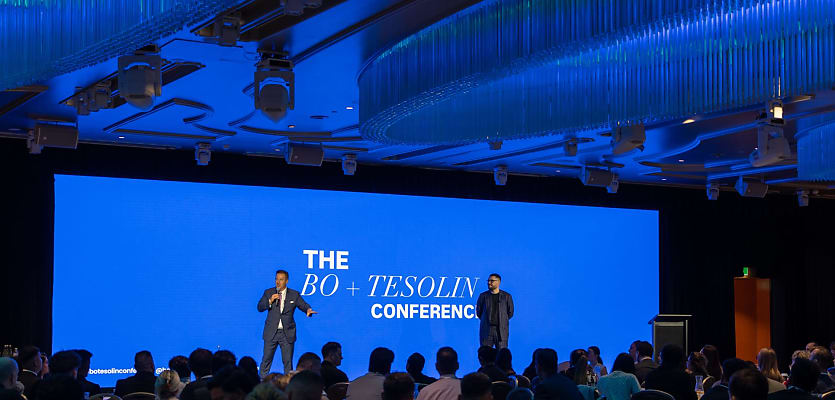

Held last week in Sydney, the sold-out Bo + Tesolin Conference pointed to an industry still looking for practical answers, sharper execution and more meaningful in-person connection.
Real estate has no shortage of conferences, coaching events or speaker line-ups. What it does have, increasingly, is a room full of agents who are more selective about what is worth their time.
That is part of what made the recent Bo + Tesolin Conference in Sydney notable. Founded by Adrian Bo and Josh Tesolin, the event drew a sold-out crowd at the Shangri-La and, more importantly, did so at a time when agents have more access than ever to online content, training programs and industry commentary
It suggests that, for all the digital noise, there is still an appetite for live events when the content feels current and the people on stage are still operating at a meaningful level within the industry.
The program leaned heavily into the themes that continue to dominate agency conversations, market share, prospecting, discipline, structure and consistency. In that respect, it felt less like an event built around broad inspiration and more like one responding to the mood of the market. Agents are not short on motivation. They are trying to work out how to stay competitive, protect momentum and keep listings flowing in a more demanding environment.
That focus was reflected in the speaker line-up, which included Adrian Bo, Josh Tesolin, Emil Juresic, Zed Nasheet, Lisa Novak, Laura Raneri, Taylah Bettini, Gemma White, Marina Makhlin, Rebecca Cuderman, Catherina Khouzami, Eddie Dilleen, Jack Henderson, Richard Baini, Matthew Everingham, Glenn Twiddle, Michael Di Veroli, Raphael Calik-Houston, Ben Spackman, Jason Yang, Bernard Desmond, Olivia Arezzolo, Roger Fabri and Rabbi Yossi Friedman.
A speaker list that long can easily become repetitive, but the mix of agents, business owners and specialists at least gave the day some range. It also reflected a broader truth about the industry, that there is no single template for relevance anymore. Different agents are building influence in different ways, and audiences are increasingly aware of that.
The strongest shift in tone came late in the day. Michael’s story, reflecting on his experience at Bondi during the recent terrorist attack, changed the energy in the room before Rabbi Yossi Friedman led a vigil that, by many accounts, left a lasting impression. It was a sharp departure from the commercial themes that had dominated the program and gave the event a very different kind of close.
The event concluded with an after party at the Ivy, which drew a strong turnout and extended the day into a more informal setting, allowing attendees to continue conversations and reconnect outside the structure of the conference.
In that sense, the Bo + Tesolin Conference seemed to reflect something broader about the current state of the industry. Agents are still willing to show up, but the bar is higher. Visibility alone is not enough. The events that cut through now are the ones that feel timely, commercially relevant and aware of the pressures agents are actually dealing with.